

Benefit from autonomous features and advanced data management
Take your inspections to the next level with the Elios 3 Premium Software Subscription. Access advanced autonomous features, transform flight data into clear asset overviews, and streamline your workflow with powerful, time-saving reporting tools.

Reduces pilot workload and stress
with autonomous navigation and flight time management assistance
Streamline flight and data analysis
through real-time data merging, live POI visualization, and asset-centric reporting

Stay always up to date and be the first
to unlock the latest software features without the need to purchase upgrades.
SUBSCRIPTION PLANS
Turn every mission into a smarter and data-rich operation
For light users
Standard
✔ Manual piloting
✔ Single flight data
✔ Fixed feature set
Designed to deliver reliable, high-quality data, the Standard Software Subscription includes all the core tools you need to fly the Elios 3 and capture critical inspection data, safely and efficiently.
Available for free with every Elios 3 drone package
For core users
Premium
✔ Assisted piloting
✔ Merged asset data
✔ Always up to date
The Premium Software Subscription helps you reduce workload and stress during data capture, streamlines data analysis, and provides a more comprehensive view of your asset.
Available for purchase as a software subscription model
Why choose a premium software subscription
ON THE FIELD
Assisted piloting
Benefit from autonomous flight features and improved time management assistance for an enhanced and more efficient piloting experience.
Automated return home
The Smart RTH feature automatically guides the drone home using the shortest and safest route — detecting and avoiding obstacles along the way. It’s designed to help pilots operate with total confidence, even in the most complex environments.
Flight time management gauge
The flight time management gauge continuously monitors battery levels and alerts the pilot when it’s time to return, calculating the shortest route back to the home point – helping maximize flight efficiency and ensure mission success.
Automated resume inspection
Resume inspection autonomously guides the drone back to the latest Return-to-Home (RTH) point via the shortest route, saving flight time and improving efficiency with every battery change!
ON THE FIELD
Autonomous data merging with relocalization
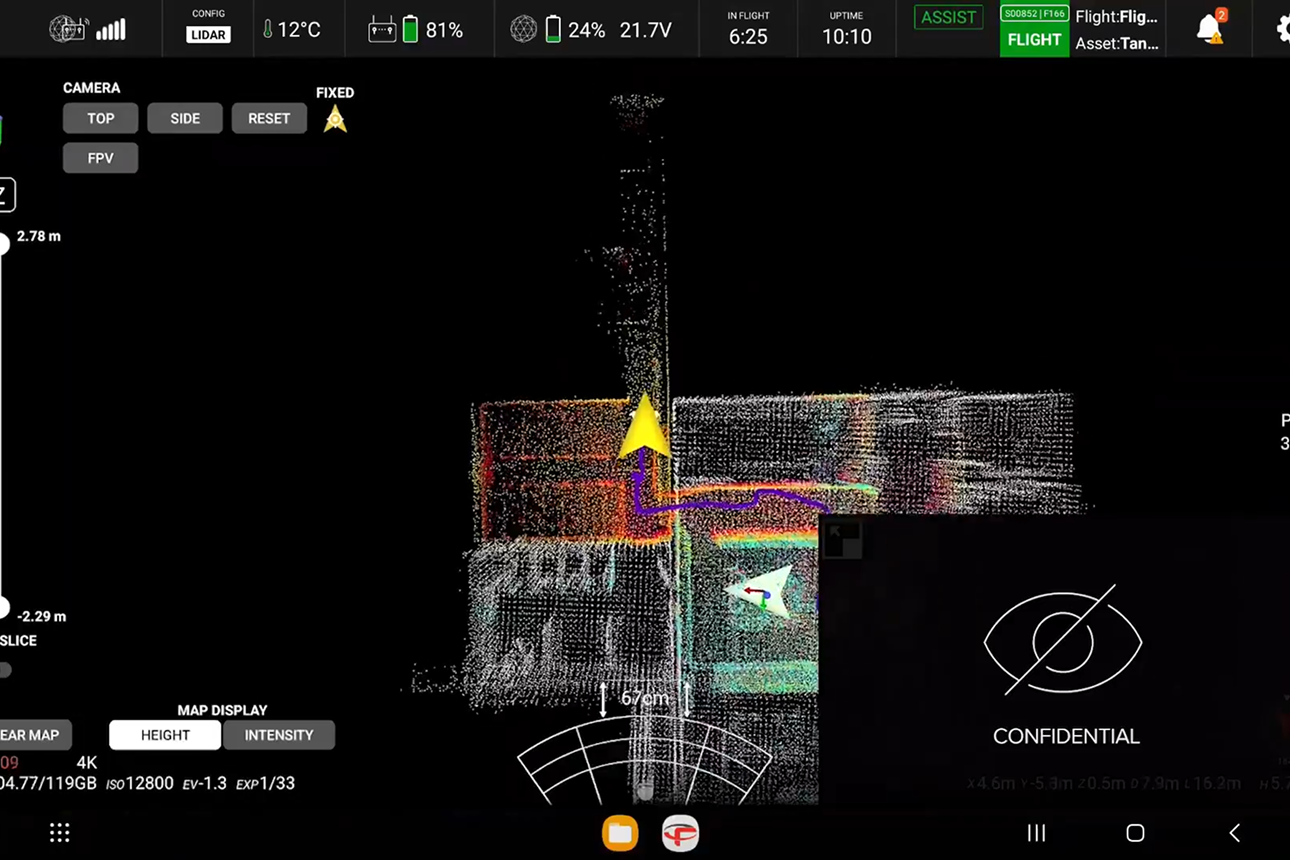
Make sense of complex assets with real-time flight merging and live POI display, to help your get the most out of each flight and have a holistic view of your asset.
Data merging at capture time
Relocalization merges newly acquired data with existing results in real time, enriching the Digital Twin of your asset with each flight. It provides a holistic view for a clearer understanding of asset condition over time.
Enhanced live map and POI display
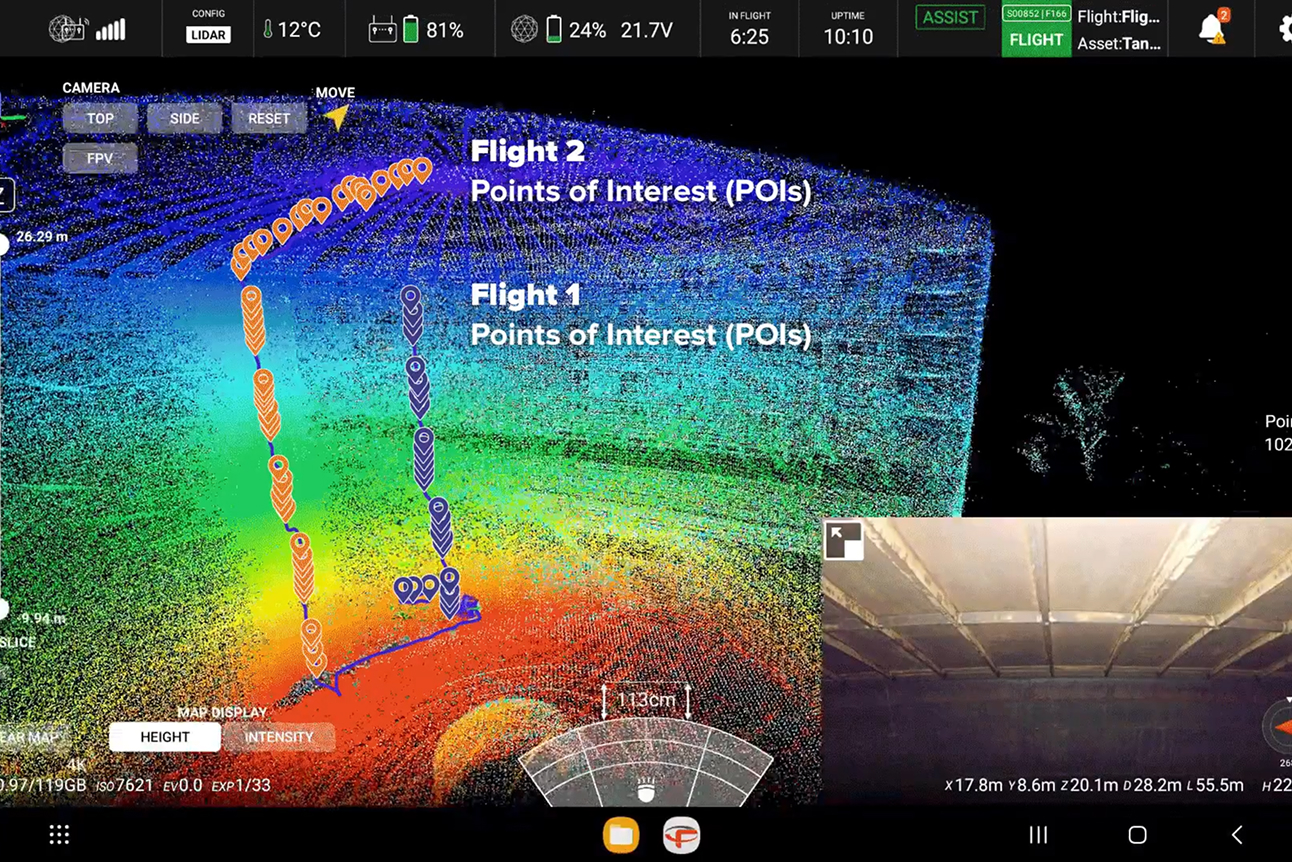
When performing an inspection spanning multiple flights, the captured maps and points of interest (POIs) are clearly displayed in the Live Map widget, serving as a reference for the pilot to easily assess project completeness.
AT THE OFFICE
Consolidated view of your asset
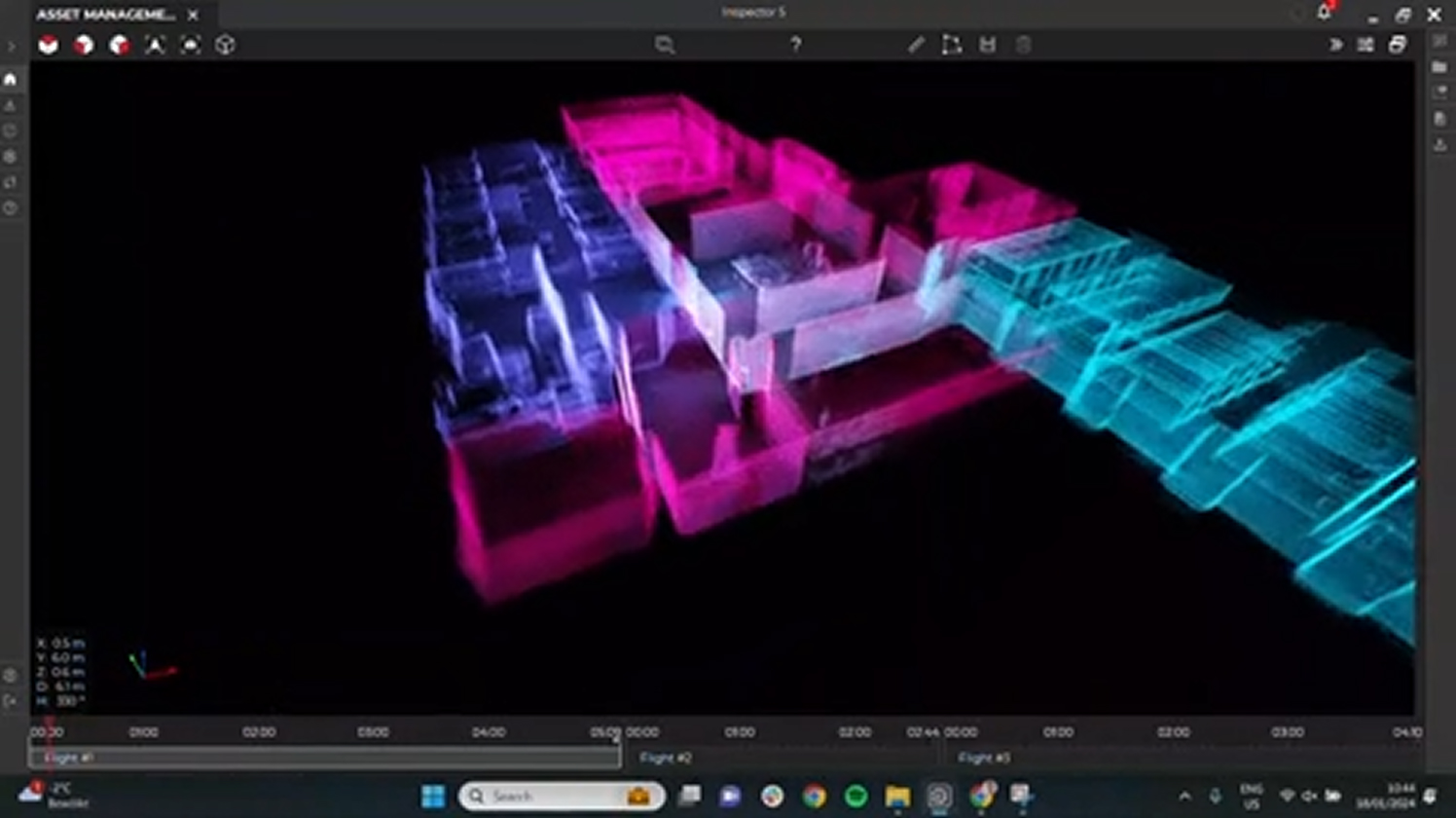
Forget single flight data and start creating comprehensive overviews of your assets by autonomously merging point clouds and unlocking advanced reporting features.
Autonomously merged asset view
With the asset-centric data viewer, point clouds, points of interest, and annotations from all flights composing an inspection are collectively displayed on a Digital Twin of your asset, providing a comprehensive view of its condition at a given time.
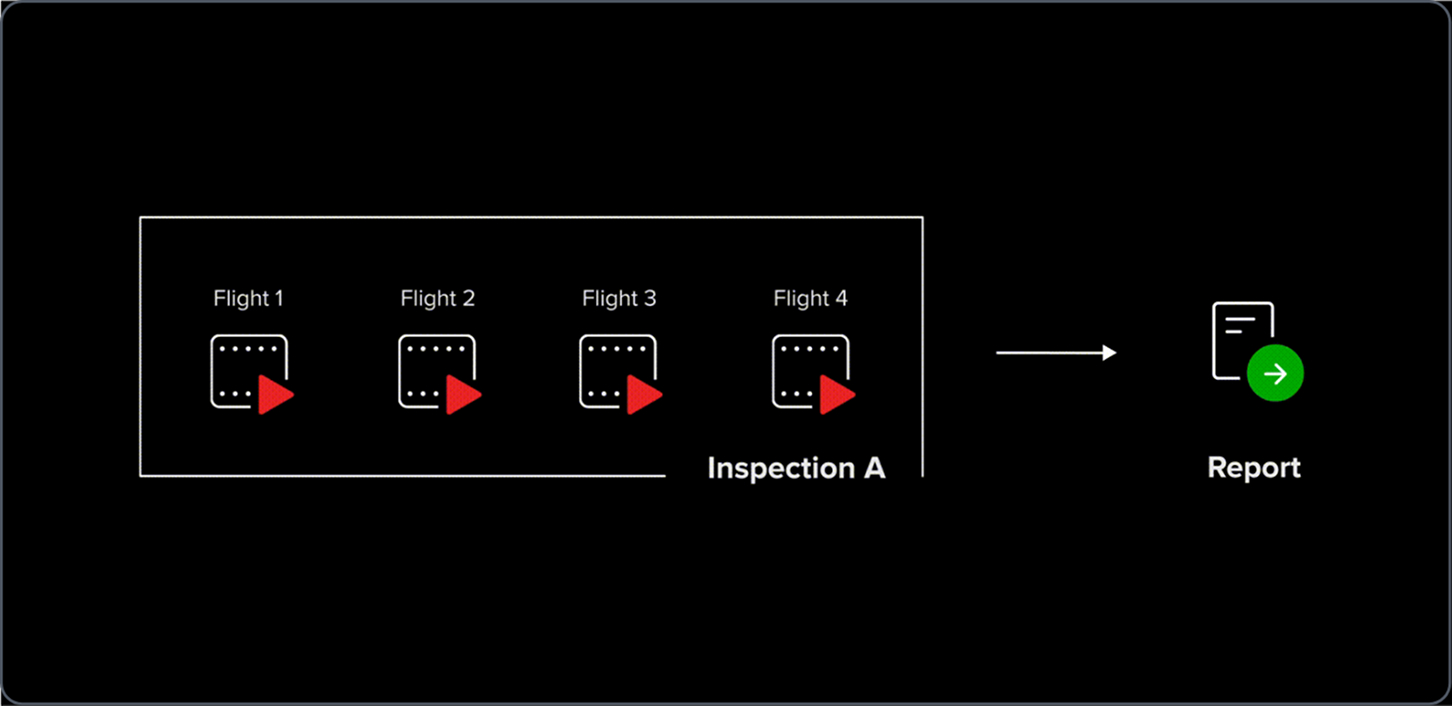
Streamlined asset reporting
When performing an inspection spanning multiple flights, the captured maps and points of interest (POIs) are clearly displayed in the Live Map widget, serving as a reference for the pilot to easily assess project completeness.
Choose the right subscription model
Cockpit
Standard
Premium
In-Flight Monitoring
Full HD Video Monitoring
3D Live Map
SLAM-Based Stabilization (Pilot assist)
LIDAR-Assist Mode (Pilot assist)
Instant Localization of POIs
Return-to-Signal (Autonomous)
Smart Return-To-Home (Autonomous)
Flight Management Gauge
Relocalization
Enhanced Live Map
Resume Inspection (Autonomous)
Repeat Inspection (Autonomous)
Start / Stop Anywhere (Autonomous)
Obstacle Avoidance (Autonomous)
Export To Drone
Inspector
Merged point clouds
Inspection-based reporting
Q&A
An acoustic camera is an imaging device used to locate and characterize sound sources. It consists of an array of microphones that simultaneously capture and process signals to create a representation of the sound source locations. This acoustic image is then overlaid in real time onto a digital camera image, enabling precise identification of the sound source.
Hertzinno’s acoustic camera, equipped with innovative architecture, AI-driven algorithms, and performance enhancements, is designed for a range of applications, including partial discharge detection, compressed gas leak detection, and mechanical fault identification.
The highly sensitive microphones of the Hertzinno Acoustic Camera can detect a broad range of acoustic frequencies, extending well beyond the audible spectrum. Hertzinno’s AI-driven algorithm effectively filters out background noise, isolating ultrasound signatures associated with gas leaks or partial discharge.
The effective range of the Acoustic Camera depends on the frequency used for detection. For leak or partial discharge detection at a distance, the 10 to 30 kHz range is ideal. Higher frequency waves are more readily absorbed by the air, resulting in shorter detection ranges. To detect leaks over longer distances or partial discharge from high-voltage equipment outdoors, the camera should be tuned to lower frequencies, which can travel further.
The effective range of the Acoustic Camera depends on the frequency used for detection. For leak or partial discharge detection at a distance, the 10 to 30 kHz range is ideal. Higher frequency waves are more readily absorbed by the air, resulting in shorter detection ranges. To detect leaks over longer distances or partial discharge from high-voltage equipment outdoors, the camera should be tuned to lower frequencies, which can travel further.
Request a Demo
Would love to see a demo? Share your contact details with us and our team will reach out to you shortly.