Introduction
Culvert and stormwater infrastructure inspection is one of the most demanding jobs in Singapore’s built environment. Between confined spaces, unpredictable terrain, poor lighting, standing water, and tight access points, asset owners and inspection teams need visual inspection solutions in Singapore that are built for the realities of local drainage and culvert networks, not generic, one-size-fits-all equipment.
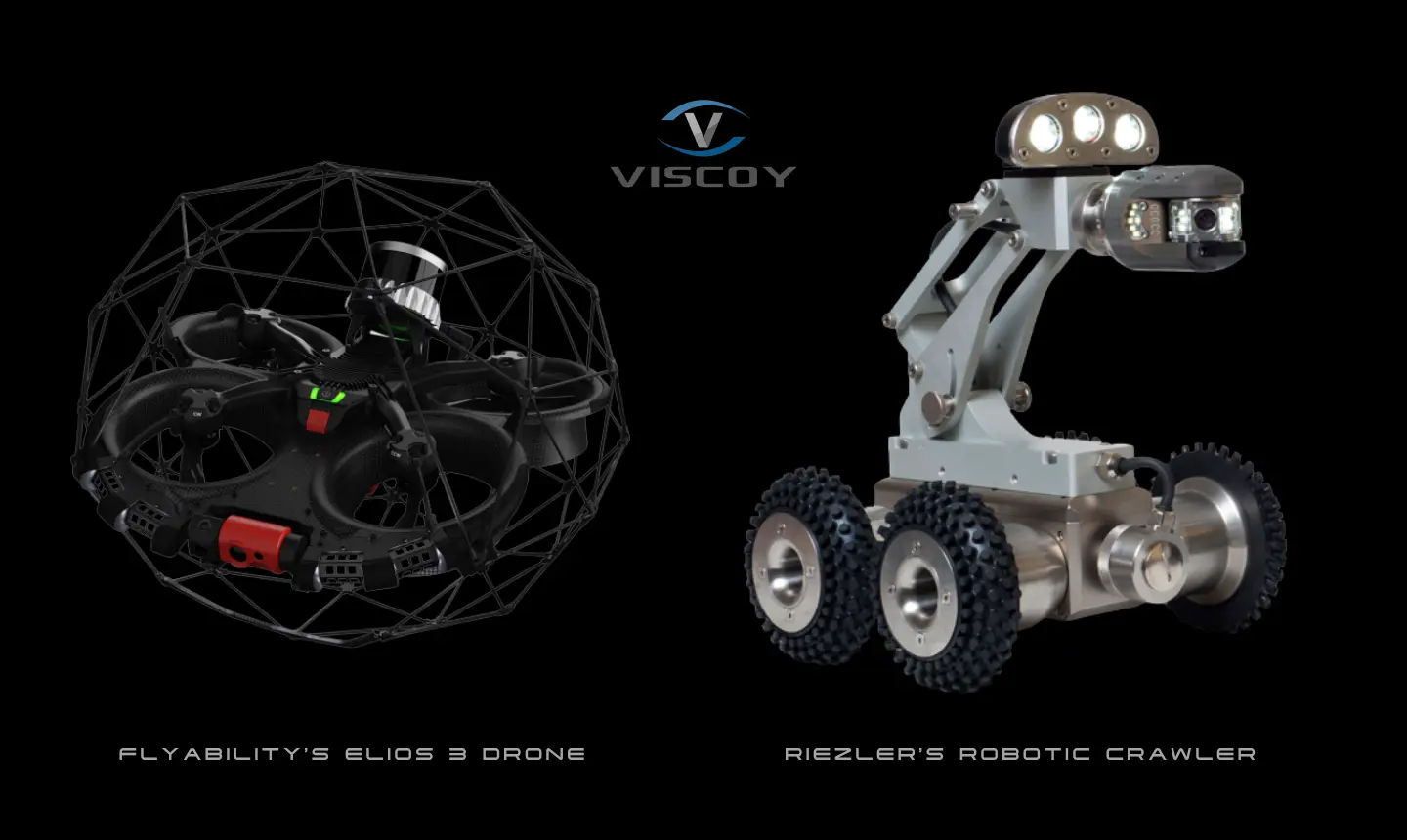
Choosing the right confined space inspection technology has a direct impact on data quality, crew safety, and how fast a project turns around. In this post, we break down the recurring challenges in culvert inspection and compare two of the most widely used platforms for remote visual inspection: RIEZLER Robotic Crawler and Flyability’s Elios 3 drone. Our goal is to help asset owners, contractors, and inspection teams across Singapore understand which tool, or combination of tools, best fits their site.
Looking for a hands-on recommendation for your culvert or stormwater project in Singapore? We help Singaporean asset owners match the right inspection equipment to the job. Speak to our team today: https://www.viscoy.com/contact-us/.
Common Challenges in Culvert and Stormwater Inspection
Before comparing equipment, it’s worth outlining the recurring challenges that shape how any inspection tool performs in the field, especially in Singapore’s dense urban drainage systems:
- Variable terrain — step drops and gradient changes within the same culvert run
- Confined spaces with limited lighting and restricted maneuvering room
- Large-diameter sections (1m and above) where standard lighting and camera resolution fall short
- Long inspection runs that push the limits of cable length or battery life
- Bends and directional changes that slow down ground-based equipment
- Water-filled sections with variable clarity, common after heavy rain
- Deployment time and manpower, particularly for manhole access in built-up areas
- Accurately localising and documenting defects for follow-up repair or maintenance action
These challenges are exactly why more contractors and asset owners in Singapore are moving toward purpose-built remote visual inspection technology instead of relying solely on manual entry or basic push-camera systems.
Two Leading Confined Space Inspection Technologies in Singapore
Two of the most common platforms deployed for culvert and stormwater inspection in Singapore today are:
- RIEZLER’s Robotic Crawler — a tethered, wheel-based ground crawler
- Flyability’s Elios 3 Drone — a collision-tolerant inspection drone purpose-built for confined spaces
Each platform brings distinct strengths depending on the culvert’s condition, size, and configuration. The comparison below outlines where each system performs best, helping you decide which visual inspection solution suits your next project in Singapore.
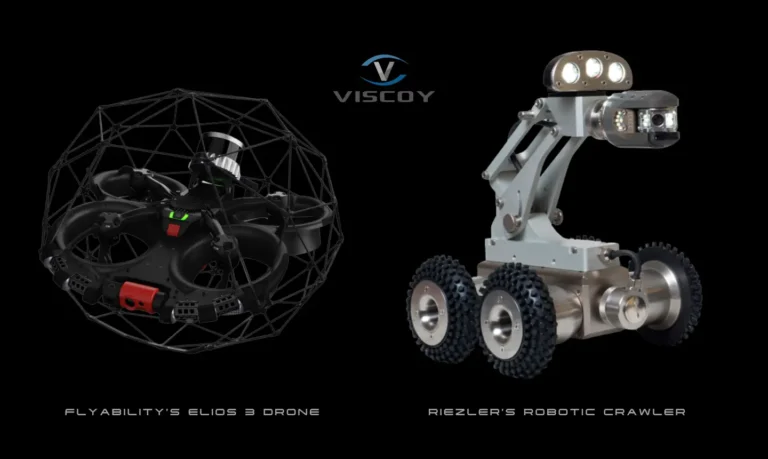
RIEZLER Robotic Crawler vs. Flyability Elios 3: Full Comparison
Factor | ||
Terrain / drop handling | May struggle with step drops (wheel-based, ground contact) | Navigates drops easily, flies above ground, no ground contact |
Large-diameter culverts (≥1m) | Limited lighting reach; camera resolution typically HD at most | Reaches any point of interest; 4K footage with 16,000-lumen lighting |
Inspection range | Up to ~250m, limited by cable length | Up to ~500m, depending on culvert configuration |
Navigating bends | Requires more time and effort | Moves between bends quickly and easily |
Deployment effort | Requires control unit, cable reel, external power, and often heavy-lifting equipment/personnel | Insert battery, connect remote control, ready to fly |
Defect localisation | Estimated distance from manhole/start point, shown as a section graphic | 3D point cloud mapping with exact defect position (ceiling/floor/side) |
Scenarios Where the Elios 3 Drone Works Better
1. Step Drops and Gradient Changes
Culverts in Singapore often have step drops or gradient changes along their length, especially in older drainage networks. As a wheel-based system, the RIEZLER crawler may struggle to overcome these drops. The Elios 3 drone, on the other hand, stays above the ground and can navigate drops freely since it has no ground contact.
2. Large-Diameter Culverts (1m and Above)
For larger diameters, the Elios 3 drone can fly directly to any point of interest and capture high-resolution 4K footage supported by 16,000 lumens of onboard lighting. The RIEZLER crawler, remaining on the ground, is often limited by lighting conditions in confined, large-diameter spaces, and its camera resolution typically tops out at HD, making it harder to capture high-quality inspection data.
3. Longer-Range Inspection
Depending on culvert configuration, the Elios 3 drone can travel up to 500 metres in a single run. The RIEZLER crawler is typically limited to around 250 metres, constrained by cable length, a meaningful difference on longer stormwater trunk lines.
4. Handling Bends
The Elios 3 drone is highly versatile when moving from bend to bend. The RIEZLER crawler requires considerably more time and effort to navigate the same transitions, which can extend site time and cost.
5. Deployment Effort
Deploying the Elios 3 drone is largely hassle-free: insert the battery, connect the remote control, and it’s ready to fly. Deploying the RIEZLER crawler requires external power and setup of multiple components (control unit, crawler, camera, cable reel, and power connections), plus heavy-lifting equipment or additional personnel to lower the crawler into the manhole, a consideration for crews working within Singapore’s manpower and safety regulations.
6. Defect Localisation
Both systems can localise defects, but the Elios 3 drone goes further. It can map the internal structure as a 3D point cloud and pinpoint the exact position of a defect. For example, whether it’s on the ceiling, floor, or side wall, information can be presented in a visual, easy-to-interpret format.
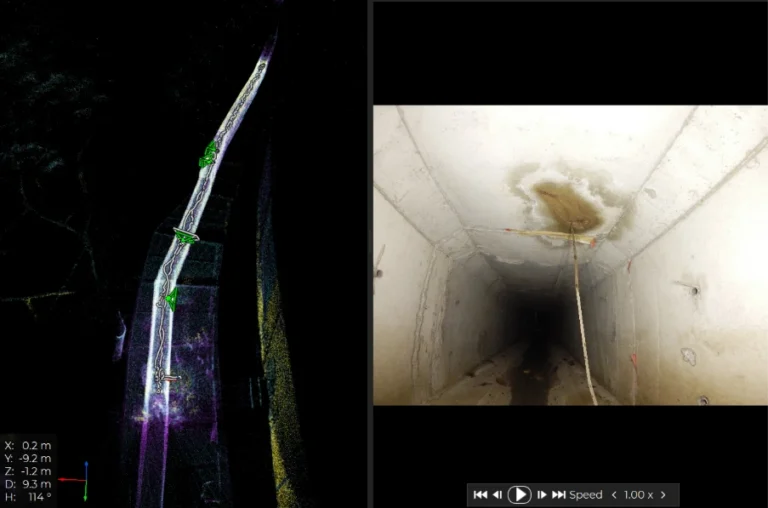
Elios 3 Drone: 3D point cloud showing exact defect location within the culvert.
By comparison, the RIEZLER crawler provides only the estimated distance of a defect from the manhole or starting point of deployment, typically represented as a section graphic.
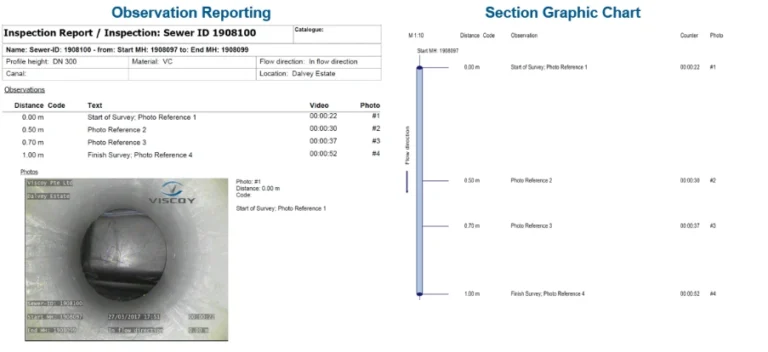
RIEZLER Crawler with Camera: Section graphic showing estimated defect distance from manhole
7. Value of the Inspection Data
Data captured by the Elios 3 drone, such as 3D point clouds, opens the door to downstream uses beyond the initial inspection, including potential modelling and surveying applications, which is useful for asset owners in Singapore to build out long-term maintenance records.
Scenarios Where the RIEZLER Crawler Works Better
1. Narrow Spaces (Under 700mm Width)
The Elios 3 drone has a 480mm diameter and needs a certain amount of space to navigate safely. In culverts narrower than roughly 700mm (common in older or smaller stormwater lines) the RIEZLER crawler‘s smaller footprint gives it the edge.
2. Water-Filled Culverts
If a culvert is filled with water and there is little to no air space for the Elios 3 drone to fly, the submersible RIEZLER crawler becomes the more practical option. This is a frequent scenario in Singapore after heavy rainfall. That said, water clarity remains a factor. If the water is too dirty, structural details can still be difficult to assess.
3. Extended Inspection Duration
The RIEZLER crawler can operate for an effectively unlimited time as long as power is supplied on site, whether by generator or direct connection, with its main limitation being the 250m cable length. The Elios 3 drone is constrained by battery runtime per flight, though it doesn’t need to remain on site for extended periods; most of its value comes from post-processing, where additional information such as 3D point clouds, defect localisation, and defect measurements can be extracted.
Which Confined Space Inspection Solution Is Right for Your Site?
Neither platform is a universal replacement for the other. The right choice depends on the culvert’s diameter, terrain, water conditions, and the level of detail required from the inspection data. In many Singapore projects, the most effective approach combines both technologies: the Elios 3 drone for larger, drier, or geometrically complex sections requiring high-resolution 3D data, and the RIEZLER crawler for narrow or submerged sections requiring extended dwell time.
Understanding these trade-offs upfront allows inspection teams and asset owners across Singapore to plan equipment selection around the specific demands of each site, improving data quality, crew safety, and operational efficiency.
Talk to an Asset Integrity Inspection Specialist in Singapore
Not sure whether a robotic crawler, drone, or a combination of both is right for your culvert or stormwater project? Our VISCOY team works with asset owners and contractors across Singapore to recommend and deploy the right asset integrity inspection and confined space inspection equipment for the job.
Get in touch with us today for a site assessment or equipment recommendation tailored to your culvert, stormwater, or industrial inspection needs in Singapore: https://www.viscoy.com/contact-us/