
Introduction
Confined space inspection has traditionally meant sending a person into a tank, boiler, pipe, or hull, often after hours of venting and gas testing, permit paperwork, and rigging just to get someone safely inside. In Singapore, where industrial, marine, and utilities sectors carry out confined space inspections on a regular basis, this process is heavily regulated, resource-intensive, and carries real safety risk.
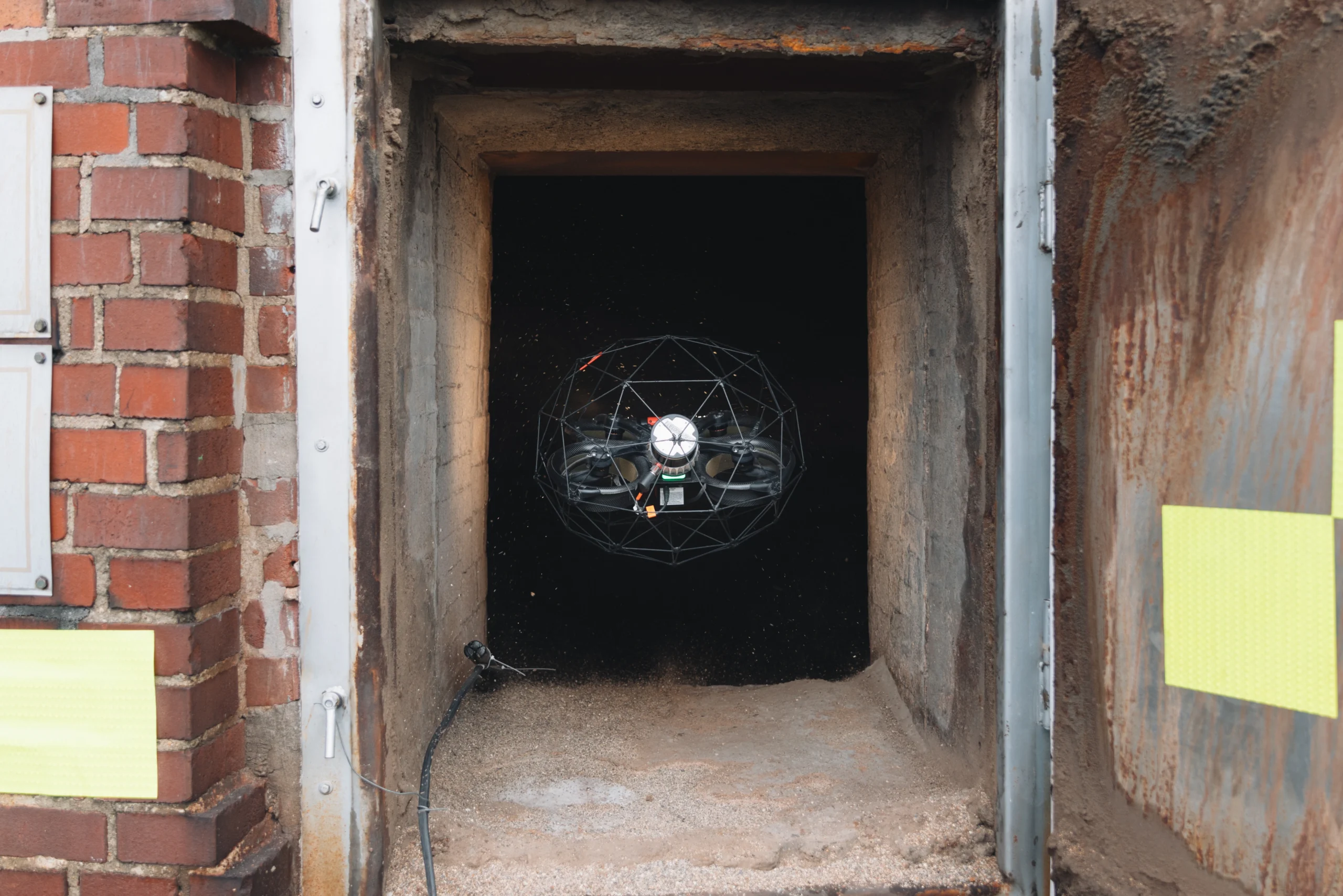
Flyability built the Elios 3 drone to remove that requirement entirely. It’s a caged, collision-tolerant drone/unmanned aerial vehicle (UAV) designed specifically to fly into small, dark, GPS-denied industrial spaces, gather inspection data and fly back out, without a person having to enter. For operators in Singapore asking how confined space inspections can be carried out more safely and efficiently, drone-based remote visual inspection solutions like the Elios 3 drone are increasingly part of the answer.
Considering a drone-based approach for your next confined space inspection in Singapore? Get in touch with VISCOY, we help teams find the right inspection equipment for the job.
How Confined Space Inspections Are Traditionally Carried Out
Before drones entered the picture, confined space inspection in Singapore typically followed a manual process: venting and gas testing to confirm the space is safe to enter, confined space permit-to-work approvals, rigging and scaffolding for access, and a trained entry team physically going inside a tank, boiler, pipe, or hull to assess its condition. This is one of the most heavily regulated and highest-risk activities in industrial work, involving hazards like oxygen deficiency, toxic gas exposure, and entrapment.
This is where a confined space drone like the Elios 3 drone changes the process. It carries out the remote visual inspection without putting a person inside the space.
What the Elios 3 Actually Does
At its core, the Elios 3 drone is a remotely piloted quadcopter, flown through Flyability’s Cockpit app on a tablet connected to a handheld controller. The pilot sees a live video feed and telemetry as the drone flies, and depending on which payload is mounted, the Elios 3 drone can capture 4K visual footage, thermal imagery, LiDAR-based 3D maps, ultrasonic thickness readings, radiation dose data and flammable gas detection (LEL – Lower Explosive Limits) — all from a safe distance outside the space itself.
Here are two features that do most of the work behind the scenes:
- FlyAware™ — Flyability‘s onboard SLAM (Simultaneous Localization and Mapping) engine, which combines LiDAR, computer vision, and an onboard graphics processor to build a real-time 3D map of the drone’s surroundings and track its exact position within it, effectively acting as an indoor GPS in environments where real GPS signal doesn’t reach.
- SLAM-based stabilisation — keeps Elios 3 drone holding still in the air even without GPS-signal, for stability that drones normally usually use outdoors. The Elios 3 drone uses visual reference points (Visual Inertia Odometry) for stability whilst indoors.
How Confined Space Inspections Are Carried Out With the Elios 3
Every part of the Elios 3 drone’s design traces back to one problem: confined industrial spaces are tight, dark, unpredictable, and unforgiving of mistakes. Here’s how Flyability engineered around that, and how it changes the way a confined space inspection is carried out on site.
A Cage Built to Crash
Unlike outdoor drones designed to avoid every obstacle, the Elios 3 drone is built around the assumption that it will hit things (i.e. tank walls, pipe supports, structural beams) regularly. Its signature protective cage, combined with a patented flight controller and motors that can run in reverse, allows the drone to bounce off a collision and recover flight stability even if it flips completely upside down. This collision-resilience is what makes flying confidently through a cluttered, unmapped interior possible in the first place.
Small Enough to Fit Through a Manhole
Confined spaces are, by definition, hard to get into. The Elios 3 drone is sized to pass through openings as small as roughly 50 by 48 centimetres, the kind of manway, hatch, or access port found on tanks, boilers, and vessels — while weighing around 2.3 kilograms with battery and standard payload.
Stable Without GPS
When outdoors, most commercial drones rely on GPS to hold position. However, inside a steel tank or underground tunnel, that GPS signal doesn’t exist. The Elios 3 drone‘s SLAM-based stabilisation holds the drone steady using its own onboard sensing instead, allowing it to hover reliably in enclosed, GPS-denied environments, including in complete darkness.
Built for the Dark
Most confined industrial spaces have no ambient light at all. The Elios 3 drone‘s oblique lighting system was designed specifically to replicate how a human inspector plays a flashlight across a surface at an angle to reveal cracks, pitting, and corrosion: lighting that flat, front-on illumination would miss entirely.
Rugged Enough for Industrial Interiors
Tank interiors and ductwork bring dust, moisture, and rough surfaces, including those found in Singapore’s marine, oil & gas, and process industries. The Elios 3 drone is engineered to comply with an IP-44-equivalent ingress protection rating and uses carbon fibre composites and magnesium alloy in its construction to stay light enough to fly while surviving repeated contact with hard surfaces.
One Airframe, Many Jobs
Rather than building a separate drone for every inspection type, Flyability gave the Elios 3 drone a modular payload bay with dedicated ports for LiDAR and auxiliary sensors. The same drone can be reconfigured for remote visual inspection, thermal scanning, 3D surveying, ultrasonic thickness testing, radiation detection and gas detection, simply by swapping the payload: a practical advantage for operators in Singapore who need one platform to cover multiple asset types.
Why This Matters for Operators in Singapore
The underlying goal is straightforward: keep people out of dangerous, hard-to-reach, or hazardous spaces while still getting the inspection data operations teams need. Confined space entry is one of the most heavily regulated and highest-risk activities in industrial work, involving risks like oxygen deficiency, toxic gas exposure, and entrapment. By sending a collision-tolerant confined space drone instead of a person, companies in Singapore can inspect more often, more safely, and often faster than a manual entry would allow, without waiting on scaffolding, confined space permits, or a full entry team.
Applications & Industries in Singapore
Application | Industry |
Tank, vessel, and boiler internal inspection | Oil & gas, power generation, chemicals |
Ship hold, ballast tank, and hull inspection | Maritime, shipping |
Duct, flare stack, and stack inspection | Cement, power generation, chemicals |
Tunnel, mine, and underground infrastructure inspection | Mining, infrastructure, tunnelling |
Sewer and large-diameter pipe inspection | Utilities, municipal infrastructure |
Reactor and containment building surveys | Nuclear power generation |
These are exactly the sectors well represented in Singapore’s industrial, marine, and utilities landscape, making confined space drone inspection an increasingly practical option for operators in Singapore looking to reduce entry risk without compromising on inspection data quality.
Carry Out Your Next Confined Space Inspection the Safer Way
If your team in Singapore is weighing up how to carry out a confined space inspection (whether that’s a tank, hull, duct, or sewer), a collision-tolerant drone like our Elios 3 drone can often get you the same inspection data without the cost, time, and risk of manual entry.
Contact us today to discuss whether our Elios 3 drone is the right fit for your next confined space inspection project in Singapore: https://www.viscoy.com/contact-us
Q&A
Yes, subject to equipment availability. Please contact us to inquire about current availability.
Yes, we offer leasing options. Please contact us to discuss the available options.
Yes, we do offer inspection services, although our primary focus is on providing equipment through sales, rental, and leasing.
Yes, product training is included with most of the equipment and solutions we provide.
We maintain stock for some of our faster-moving products. Please contact us to check the availability of the specific product you are interested in.