TETHER POWER UNIT

Accessory

Continuous power. Stress-free operations.

Fly without time constraints

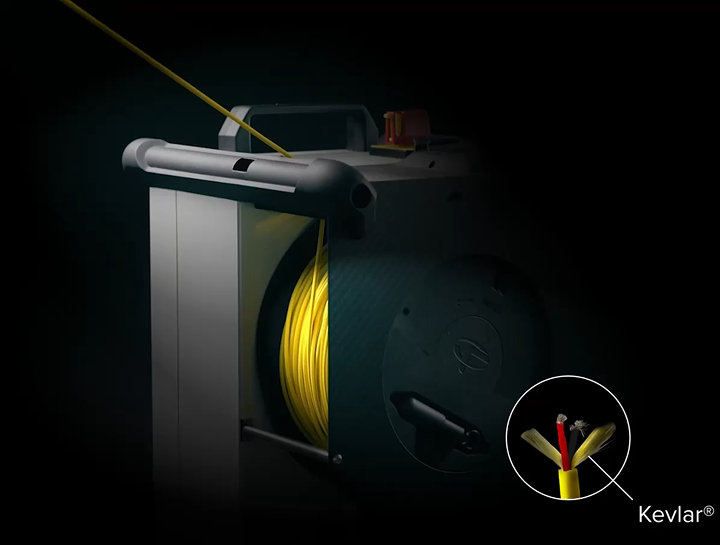
The Elios 3 tether unit delivers continuous power for long, stress-free operations. By connecting to a wall outlet, generator, or compatible portable power station, it converts 100–240 V AC into high-voltage DC, delivered to the drone through a 50 m (164 ft) Kevlar®-reinforced cable. With steady power from the ground, pilots can eliminate mid-mission battery changes and stay focused on the inspection.

Full mission focus

Removes flight-time constraints, allowing the pilot to focus entirely on the mission.

Uninterrupted efficiency

No battery charging or swaps. Pilots stay on task, maximizing mission output.

Extra peace of Mind

The tether serves as a safety lifeline, giving pilots confidence in every mission.

Anti-Flip Swivel

Easy Tether-to-Battery
Swap

Kevlar-Reinforced
Tether Cable

Backup Battery

Worldwide Power
Compatibility

EU C5 Classified

Anti-Flip Swivel

Fly as freely as if untethered

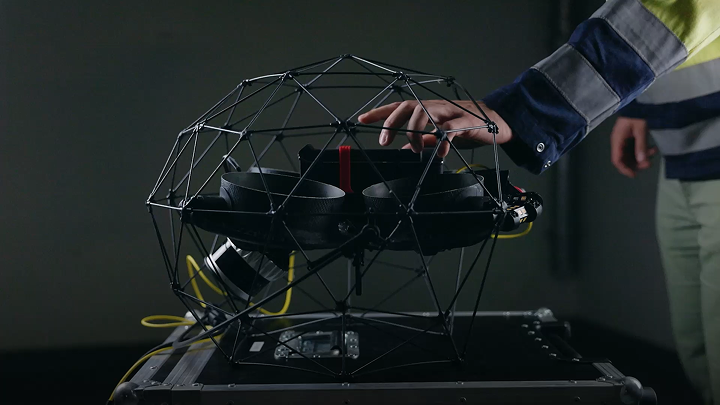
Building on Flyability’s proven collision-tolerant know-how, the anti-flip swivel secures the cable while allowing it to move freely around the drone, eliminating disturbances from the tether. This ensures perfect stability, even during sharp maneuvers or a cable snag.


The swivel rotates 360° around the drone, allowing the tether to attach from any direction. This rotation removes directional constraints, ensuring inspections are never limited by tether orientation.

Easy Tether-to-Battery Swap

Easily switch from tethered to untethered flight

The air unit connects the cable to the drone and can be swapped with an Elios 3 battery in seconds. This lets pilots fly beyond the tether’s reach, ensuring complete data collection in all conditions.

Kevlar-Reinforced
Tether Cable

Rugged cable for demanding missions

The 50 m (164 ft) tether cable is made from lightweight, high-strength Kevlar® fiber, offering exceptional durability and a tensile strength of up to 50 kg. Its robust construction ensures reliable performance and resistance to wear, even in demanding operational environments.

Backup Battery

Land safely in unexpected power outages

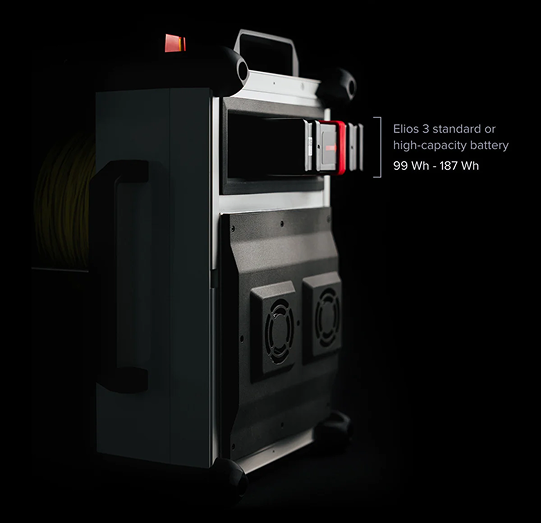
The tether ground power unit is equipped with a backup battery either Elios 3 standard or high-capacity battery that automatically supplies enough power for a safe, controlled landing during unexpected power loss.

Worldwide Power
Compatibility

Plug in Anywhere in the World

Supports 100–240 V AC input, making it compatible with most power outlets worldwide.

EU C5

Classified

Unlock new mission possibilities

Elios 3 tethered is compliant with the C5 class marking under EU regulations, enabling STS-01 operations in populated environments.

Q&A

An acoustic camera is an imaging device used to locate and characterize sound sources. It consists of an array of microphones that simultaneously capture and process signals to create a representation of the sound source locations. This acoustic image is then overlaid in real time onto a digital camera image, enabling precise identification of the sound source.

Hertzinno’s acoustic camera, equipped with innovative architecture, AI-driven algorithms, and performance enhancements, is designed for a range of applications, including partial discharge detection, compressed gas leak detection, and mechanical fault identification.

The highly sensitive microphones of the Hertzinno Acoustic Camera can detect a broad range of acoustic frequencies, extending well beyond the audible spectrum. Hertzinno's AI-driven algorithm effectively filters out background noise, isolating ultrasound signatures associated with gas leaks or partial discharge.

The effective range of the Acoustic Camera depends on the frequency used for detection. For leak or partial discharge detection at a distance, the 10 to 30 kHz range is ideal. Higher frequency waves are more readily absorbed by the air, resulting in shorter detection ranges. To detect leaks over longer distances or partial discharge from high-voltage equipment outdoors, the camera should be tuned to lower frequencies, which can travel further.

The effective range of the Acoustic Camera depends on the frequency used for detection. For leak or partial discharge detection at a distance, the 10 to 30 kHz range is ideal. Higher frequency waves are more readily absorbed by the air, resulting in shorter detection ranges. To detect leaks over longer distances or partial discharge from high-voltage equipment outdoors, the camera should be tuned to lower frequencies, which can travel further.

Request a Demo

Would love to see a demo? Share your contact details with us and our team will reach out to you shortly. 

Scroll to Top