
Introduction
For inspectors working inside tanks, boilers, chimneys, and other confined industrial assets in Singapore, Flyability’s Elios 3 drone has already removed the biggest risk in the job: sending a person into a hazardous space. But even the safest drone still runs on a battery, and every battery has a clock attached to it. A standard Elios 3 battery delivers around 12 minutes of flight time; the high-capacity battery stretches that to roughly 17 minutes. For a quick visual check, that’s plenty. For an ultrasonic thickness (UT) survey across a large vessel, a full point cloud capture of a tank interior, or a long crawl down a culvert or duct, it usually isn’t.
Every battery swap means landing the drone, walking it back to the entry point, replacing the pack, and re-establishing the flight path, time that adds up quickly on a job where access itself is already difficult. This is the gap the Elios 3 Tether Power Unit was built to close, and it’s changing how confined space inspection in Singapore gets carried out for large or long-duration jobs.
Curious whether the Elios 3 Tether Power Unit fits your next inspection job in Singapore? Get in touch with us and we can talk through setup, power requirements, and site planning: https://viscoy.com/contact-us
What the Elios 3 Drone Tether Power Unit Is
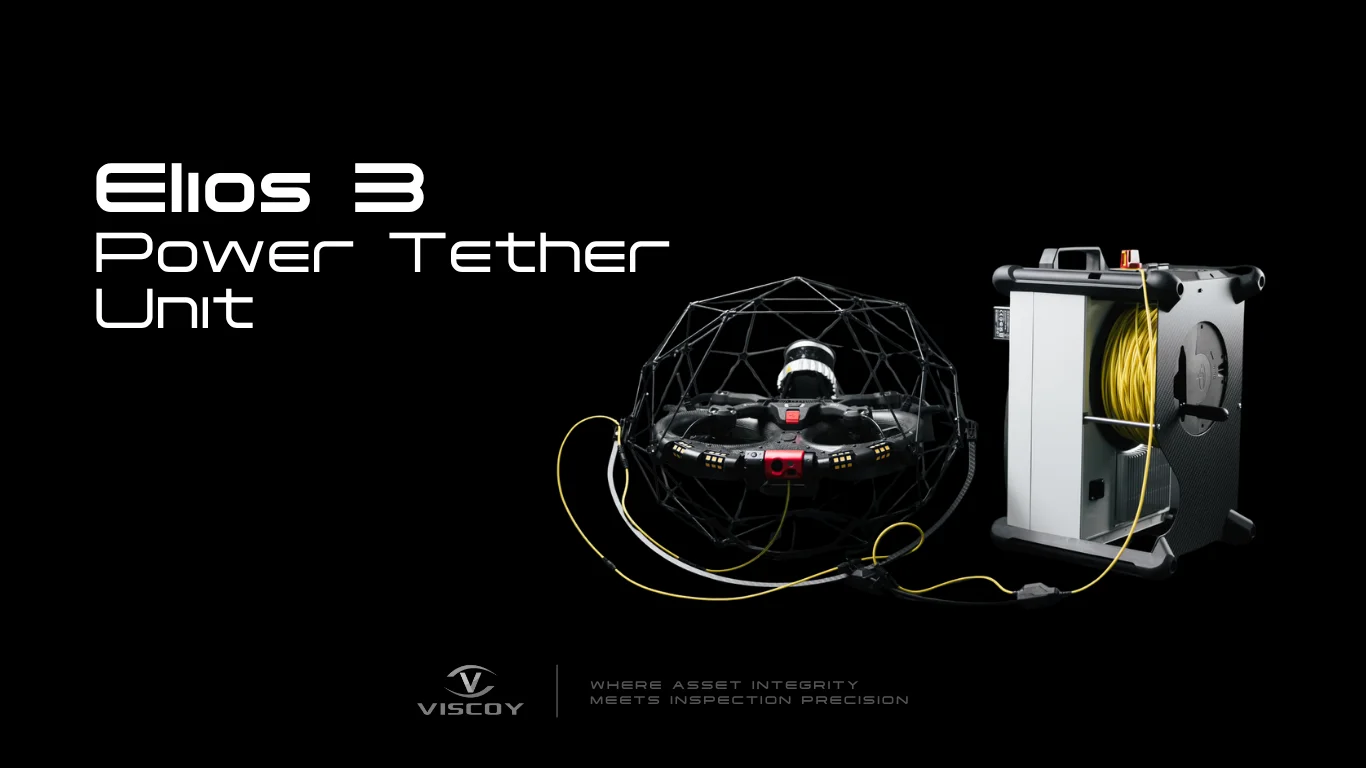
Released by Flyability in 2026, the Elios 3 Tether Power Unit is a ground-based power system that delivers continuous power to the Elios 3 drone through a cable, eliminating the need for mid-mission battery changes entirely. Instead of running down a battery and landing to swap it, the drone stays powered from the ground for as long as the inspection requires.
Core specifications
- Cable — 50m (164ft) Kevlar®-reinforced tether with a tensile strength of 50kg (110lb), built to withstand snagging and abrasion in industrial environments
- Power conversion — the ground unit accepts 100–240V AC from a wall outlet, generator, or portable power station, and converts it to high-voltage DC for transmission up the cable
- Typical draw — approximately 10A at 230V, or 20A at 120V. Field deployments away from mains power call for a generator rated at 2.5kVA or higher
- Air unit — a small module that connects the tether to the drone and swaps in and out of the standard Elios 3 battery bay in seconds, allowing the pilot to move between tethered and battery-powered flight within the same mission
- Anti-flip swivel — a tension-decoupling, 360°-rotating swivel keeps the cable from imposing torque or drag on the drone, preserving the Elios 3’s collision-tolerant flight characteristics even under tether load
- Backup battery — an integrated backup cell activates automatically if ground power is interrupted, giving the pilot enough reserve power to fly the drone back and land safely
Setup
Installation requires no permanent modification to the drone. Two small brackets mount onto the Elios 3 drone cage, the drone mount attaches with two manual screws, the air unit slots into the battery holder in place of a standard battery, and the ground unit is powered up. Flyability states the full setup takes only a few minutes, which matters on sites in Singapore where productivity is a priority.
Use Cases
The tether doesn’t replace battery-powered flight, but complements it, and Flyability has been explicit that the two modes are meant to be used together depending on the mission. A few scenarios where the tether earns its place:
Ultrasonic Thickness (UT) Testing
Flyability introduced the UT payload for the Elios 3 drone in 2024, but on battery power alone, flight time capped how much of a vessel or structure could be surveyed in a single sortie. NDT missions typically require the drone to hold position against a surface for a period of time while readings are taken at each point, the kind of task that eats into a 12-to-17-minute battery budget. With continuous power, a UT survey in Singapore can run for as long as the job requires without a mid-survey interruption.
Large Tanks, Vessels, and Boilers
Comprehensive interior surveys (i.e. full-tank LiDAR mapping, complete visual coverage of a boiler interior, or condition assessments of large flue gas ducts) often involve covering far more surface area than a single battery allows. The tether lets the drone pilot complete a full pass of a large asset in one continuous flight, reduces or completely do away with the need to stitch point clouds from multiple flights together.
Long-Transit Inspections
Culverts, long ducting runs and deep shafts can require several minutes of flight just to reach the area of interest before any actual inspection work begins. On a battery, that transit time is a direct subtraction from usable inspection time. On the tether, transit time stops being a budget line. This becomes a practical advantage for many underground utility and stormwater networks in Singapore.
Offshore and Industrial Field Trials
Flyability has already tested the tether in demanding field conditions, including trials with Shell on an offshore platform, where the Elios 3 drone was used to map hard-to-access structures on the underside of a deck. Oil and gas, power generation, mining, and maritime infrastructure are all expected to be strong adopters, given the combination of large assets and expensive downtime in those sectors, relevant to Singapore’s marine, offshore, and process industries.
Tethered vs. Battery-Only Flight
The tether is best understood as an additional tool rather than a replacement for standard battery flight. The table below summarises when each approach makes sense.
Factor | Battery-Only Flight | Tethered Flight |
Flight time | Up to ~12 min (standard battery) or ~17 min (high-capacity battery) | Continuous, limited only by pilot endurance and onboard memory |
Mid-mission interruptions | Battery swaps required, pausing data collection | None, pilot stays focused on the inspection |
Best suited for | Short, targeted flights and quick visual checks | UT/NDT surveys, large tanks and vessels, long transit routes |
Safety fallback | Return-to-pilot on low battery | Integrated backup battery for a controlled landing on power loss |
Setup | None required | A few minutes to mount brackets and connect the air unit |
Power source | N/A | Wall outlet, generator (≥2.5kVA), or portable power station |
Key Advantages of the Tether
- Removes flight-time anxiety — drone pilots can concentrate on flying and reading data instead of watching a countdown timer
- No mid-mission battery swaps, which keeps data collection continuous and avoids re-establishing position after every landing
- Built-in safety margin — the backup battery ensures a controlled landing even if ground power is lost unexpectedly
- Fast setup that doesn’t permanently alter the drone, so operators can switch back to standard battery flight for shorter or more manoeuvrable missions
- The anti-flip, tension-decoupling swivel means the tether doesn’t compromise the collision-tolerant handling the Elios 3 drone is known for
Practical Considerations for Deployments in Singapore
The tether does introduce a few planning requirements worth flagging before deployment:
- A suitable power source is needed on site (i.e. mains power, or a generator/power station rated at 2.5kVA or more for remote or offshore locations)
- The 50m cable defines the maximum operating radius from the ground unit; missions requiring greater range still call for battery-only flight or the Elios 3 Range Extender
- As with any tethered system, cable management on site such as routing around obstacles, entry points, and personnel, should be planned as part of the mission briefing, particularly on tight industrial sites common across process and manufacturing facilities in Singapore
Conclusion
The Tether Power Unit addresses the one constraint that battery technology alone couldn’t solve for the Elios 3: how long the drone can stay in the air on a single mission. For quick checks, the standard battery remains the simpler choice. But for UT surveys, large-asset mapping, and long-transit inspections, missions where inspection quality depends on uninterrupted coverage. The Tether Power Unit can turn the Elios 3 drone into a platform that can stay on task for as long as the job takes.
As Patrick Thévoz, Flyability’s CEO and co-founder, has put it, power tethering is designed to be highly complementary to battery flight, maximising the efficiency of inspection, surveying, and monitoring operations rather than replacing the flexibility that made the Elios 3 drone the standard in confined space inspection in the first place.
Add Unlimited Flight Time to Your Elios 3 Setup
If your team in Singapore is running UT surveys, mapping large tanks, or covering long inspection routes with the Elios 3 drone, the Tether Power Unit can remove flight time as a limiting factor altogether. Get in touch with VISCOY to find out whether the Elios 3 Tether Power Unit is the right addition to your inspection setup, and to plan power requirements for your next deployment.