
Introduction
Flyability’s Elios 3 drone is built around a modular payload bay, so a single collision-tolerant drone can be reconfigured for visual inspection, thermal scanning, 3D mapping, ultrasonic thickness testing (even performing surface cleaning before UT), or radiation surveying. All without redesigning the airframe. For teams carrying out confined space inspection in Singapore, this means one drone platform can cover tank, hull, pipe, and plant inspections that would otherwise need several separate tools.
Our guide walks you through on how to use each of the 8 Elios 3 drone payloads currently available, how each one works, and the industries and use cases it’s best suited for, so operators in Singapore can figure out which configuration fits their next job.
Not sure which Elios 3 payload suits your inspection needs? Get in touch with VISCOY — we help teams across Singapore choose and set up the right configuration for confined space inspections.
Overview: A Modular Platform, Not a Single-Purpose Drone
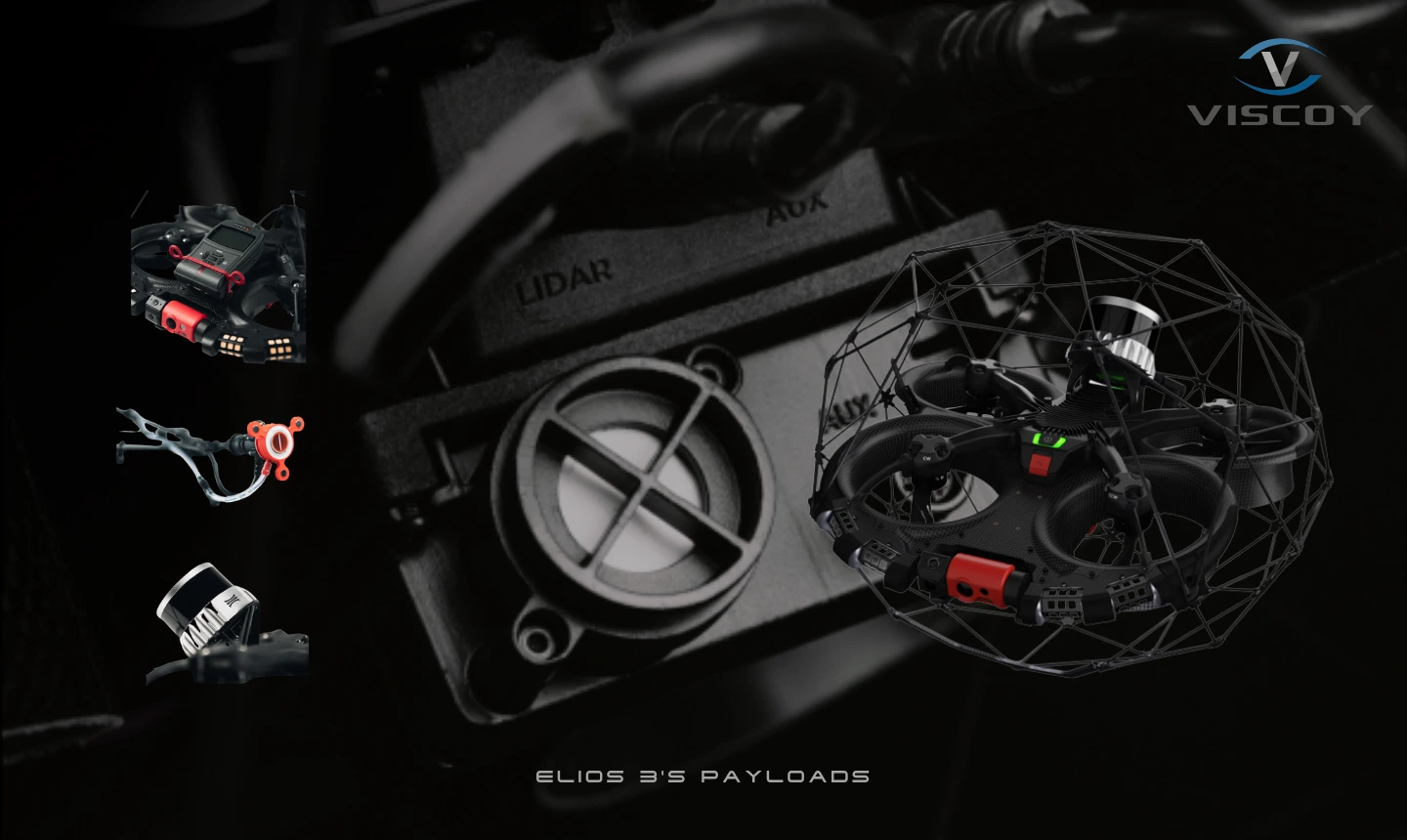
The Elios 3’s payload bay has two dedicated ports: one for LiDAR and one for auxiliary sensors, allowing operators to swap tools based on the mission rather than purchasing a separate robot for every inspection type. Here are the eight payload configurations:
- Visual Inspection — 4K Camera (Standard Payload)
- Thermal Camera (Standard Payload)
- Standard LiDAR Payload (Ouster OS0-32)
- Surveying LiDAR Payload (Ouster OS0-128 + FARO Connect Software)
- Ultrasonic Testing (UT) Payload
- Cleaning Module Payload (Part of UT Payload Package)
- Radiation Detection (RAD) Payload
- Flammable Gas Sensor Payload
1. Visual Inspection — 4K Camera (Standard Payload)
Every Elios 3 drone ships with the close-up inspection payload as standard. It’s built around a 4K camera with an unobstructed 180° field of view, delivering a resolution of roughly 0.18mm per pixel at 30cm, close to what a human inspector would see standing at arm’s length from the surface. It’s paired with a distance sensor and an oblique, lighting feature that is designed to replicate the way an inspector plays a flashlight across a surface at an angle to reveal cracks, pitting, and corrosion that flat lighting would hide. The Elios 3 drone is equipped with 16,000 lumen lighting system, ensuring the visual inspection is never limited by illumination levels. Unique dust-proof lighting enables the operator to navigate dusty environments common in industrial confined spaces.
A distance-lock feature lets drone pilots hold a fixed standoff from welds, beams, or vessel walls, keeping footage consistent and repeatable across inspection cycles, which is useful for before/after comparisons over time.
Applications & Industries
Application | Industry |
Boiler and pressure vessel internal inspection | Power generation, chemicals, oil & gas |
Storage tank and vessel condition assessment | Oil & gas, chemicals, maritime |
Weld, beam, and structural integrity checks | Oil & gas, infrastructure, construction, maritime |
Duct, flare stack, and confined structural inspection | Oil & gas, cement, power generation, chemicals |
General condition monitoring in hard-to-reach areas | All industries and applications |
2. Thermal Camera Payload
The thermal camera payload equips the Elios 3 drone with a radiometric thermal sensor capable of reading temperature differentials across a surface and measuring absolute temperature at any point in the frame. In Flyability’s Inspector and Cloud software, the thermal feed can be overlaid on the live RGB video and on the LiDAR point cloud, and operators can hover over any pixel to read an exact temperature value.
Because it identifies heat anomalies invisible to the naked eye, the Elios 3 thermal inspection drone payload is used to catch problems (i.e. overheating components, insulation failure, and fluid or gas leaks) before they progress into failures.
Applications & Industries
Application | Industry |
Electrical hotspot and switchgear inspection | Power generation, utilities |
Refractory wear and insulation loss detection | Cement, chemicals, oil & gas |
Steam, gas, or fluid leak detection | Chemicals, oil & gas, power generation |
Overheating equipment / bearing and motor checks | Process plants, manufacturing, mining |
Fire cause and hot-spot investigation in confined structures | Fire departments, insurance, infrastructure |
3. LiDAR Payload (Standard Configuration)
The standard LiDAR payload is built around the Ouster OS0-32 Rev 6.2 sensor and works together with FlyAware™, Flyability‘s onboard SLAM (Simultaneous Localization and Mapping) engine. Rather than relying on GPS (which doesn’t work indoors), the drone uses the LiDAR point cloud, computer vision, and an onboard NVIDIA graphics engine to build a real-time 3D map of its surroundings and track its own position within it to centimetre accuracy.
This is what enables stable flight in GPS-denied spaces, live situational awareness for the pilot, a visual record of inspection coverage, and reliable return-to-home navigation along the drone’s original flight path. This is core to any drone inspection payload used for confined space work.
Applications & Industries
Application | Industry |
Real-time 3D localisation and navigation in confined spaces | All industries operating Elios 3 drone |
General-purpose indoor mapping and spatial awareness | Mining, infrastructure, cement |
Quick volumetric estimates of product stockpiles in tanks, silos, or warehouses | Cement, mining, oil & gas, agriculture |
Situational awareness during visual/thermal inspection flights | All industries operating Elios 3 drone |
4. Surveying LiDAR Payload
The Elios 3 Drone Surveying Payload upgrades the Elios 3’s LiDAR to the higher-resolution Ouster OS0-128 Rev 7 sensor generating 1.3 million points per second; more than 4x that of the standard LiDAR. The combination of a denser 3D point cloud with the Surveying Payload and the FARO Connect point cloud processing software is aimed at professional surveyors who need survey-grade LiDAR mapping rather than general situational-awareness mapping.
It ships with reflective targets that let FARO Connect automatically align and georeference multiple point cloud scans into a single dataset, plus tools for filtering, outlier removal, noise reduction, and export to standard survey formats (LAZ, LAS, PLY, TXT, and E57).
On drift and accuracy: Flyability reports the Surveying Payload achieves a mapping accuracy of roughly ±1.0cm with drift as low as ±0.1% in structured, feature-rich environments such as tunnels, tanks, and industrial plant interiors (around five to ten times more accurate than the standard LiDAR configuration). Drift performance depends heavily on the geometry of the space being scanned: highly structured environments with distinct surfaces and edges give the SLAM algorithm more reference points to lock onto, while open or repetitive environments are more prone to accumulated drift over a flight.
With a 100-metre range, a point density of roughly 1.3 million points per second, and the ability to cover a 300-metre closed-loop tunnel in a single flight, the Surveying Payload can compress what would take days of manual survey work into a single short flight. Like the standard configuration, it fits through openings as small as 50×50cm.
Purchasing note: The Surveying Payload can be purchased as a bundle with a new Elios 3 drone or as a standalone add-on for existing Elios 3 drone owners in Singapore. If you’d like to request for a demo, contact us today: https://www.viscoy.com/contact-us/
Applications & Industries
Application | Industry |
Survey-grade digital twins of tanks, vessels, and plant interiors | Oil & gas, chemicals, power generation |
Underground mine and tunnel mapping | Mining, tunnelling, infrastructure |
Volumetric and stockpile measurement | Cement, mining, aggregates |
Scan-To-BIM applications | Construction, infrastructure |
5. Ultrasonic Testing (UT) Payload
Developed jointly with Cygnus Instruments (a company with over 40 years of experience in ultrasonic thickness gauging), the Ultrasound Thickness Measurement (UT) Payload turns the Elios 3 drone into a remotely piloted thickness-measurement tool for ultrasonic thickness testing. The probe is mounted on a smart arm that can be positioned in multiple orientations, featuring a laser pointer for precise aiming, and can be mounted on top of, in front of, or below the drone depending on the geometry of the target.
Probe types and their uses:
- 2 MHz twin crystal piezo-composite probe — best for heavily corroded, pitted, or rough surfaces and thicker materials, where lower frequencies penetrate more reliably through surface irregularities
- 5 MHz twin crystal piezo-composite probe — the general-purpose choice for standard steel plate and pipe wall thickness gauging under typical industrial conditions
- 7.5 MHz twin crystal piezo-composite probe — suited to thinner materials and applications needing finer resolution near the surface, where higher frequency improves measurement precision
- 2.25 MHz single crystal (multi-echo) probe — complies with IACS (International Association of Classification Societies) special equipment requirements, making it suitable for class surveys and thickness measurement on ship hulls and mobile offshore units, relevant to Singapore’s maritime and offshore sector
Location tagging: Because the UT Payload can run in parallel with the LiDAR payload, every thickness reading is automatically geo-tagged onto a 3D digital twin of the asset as it’s captured. Combined with the drone’s relocalisation feature and the Live Map widget in Flyability’s Cockpit app, this lets operators see exactly which points have already been measured and navigate straight back to any location of interest, which is critical for tracking inspection coverage across large tanks, hulls, or pipe racks.
Couplant dispensing: Accurate ultrasonic readings require a couplant gel to transmit the signal into the material being tested. The UT Payload includes a remotely operated couplant dispenser built into the probe head, so the pilot can dispense just the right amount on demand during flight. Couplant level is monitored live through Cockpit, and the drone can return to base for a quick refill or a rapid syringe swap when it runs low.
Applications & Industries
Application | Industry |
Hull and ballast tank corrosion surveys | Maritime, shipping |
Storage tank’s wall thickness gauging | Oil & gas, chemicals |
Pipe rack and piping wall thickness measurement | Oil & gas, chemicals, power generation |
Pressure vessel integrity checks | Oil & gas, power generation, chemicals |
Class-compliant thickness surveys on mobile offshore units | Maritime, offshore energy |
6. Cleaning Module Payload
Corroded, scaled, or coated surfaces often can’t be measured accurately until they’re cleaned. The Cleaning Module swaps directly onto the UT Payload’s probe arm in place of the ultrasonic probe head, allowing the Elios 3 drone to remove surface deposits and light rust, and prepare a clean measurement point without anyone entering the space.
Because the Elios 3 drone’s flight and measurement locations are geo-tagged on the same digital twin, an operator can clean a spot with the cleaning module, then swap back to the UT probe and fly straight back to that exact same location to take an accurate thickness reading, avoiding the need to reclean or hunt for the same spot twice.
Applications & Industries
| Application | Industry |
| Surface prep ahead of UT thickness measurement on corroded steel | Oil & gas, maritime, chemicals |
| Removing light debris or coatings ahead of visual/UT survey | Infrastructure, maritime |
7. Radiation (RAD) Payload
Released in May 2023 as the first modular payload for the Elios 3 drone, the Radiation Detection (RAD) Payload was developed in partnership with Mirion Technologies for fast, accurate radiation surveys in indoor spaces without exposing personnel to risk. It’s compatible with Mirion’s RDS-32 WR sensor family, which can be swapped in as needed, and reads dose rates from µSv/h up to Sv/h.
During flight, every radiation measurement is recorded alongside the Elios 3 drone’s visual and mapping data. In post-processing, the drone’s flight trajectory is colourised according to the instant dose rate reading, letting operators visually pinpoint radiation sources on a 3D map of the asset. The payload also tracks current and cumulative dose rate along with the maximum recorded value, which supports both hot-spot identification and dose-exposure planning for any personnel who do need to enter the area afterward.
The RAD Payload is already deployed at multiple nuclear power plants and waste management sites worldwide, including Sellafield, and Flyability reports that over 80% of U.S. nuclear reactors use its technology in some form.
Applications & Industries
Application | Industry |
Radiation dose-rate mapping inside reactor and containment buildings | Nuclear power generation |
Radioactive waste storage site surveys | Nuclear waste management |
Decommissioning support and hot-spot identification | Nuclear power generation |
Pre-entry dose planning for maintenance personnel | Nuclear power generation |
8. Flammable Gas Sensor Payload
For inspections in hazardous atmospheres (i.e. oil & gas facilities, wastewater treatment plants, chemical sites, and other environments where flammable gases may be present), Elios 3 drone’s Flammable Gas Sensor Payload gives the pilot real-time awareness of gas conditions before and during a confined space inspection in Singapore’s industrial sites. Factory-calibrated and equipped with built-in self-testing, it requires no field calibration, supporting continuous fail-safe operation in harsh environments such as oil & gas, mining, maritime, chemical, wastewater treatment, and industrial manufacturing facilities.
Built on NevadaNano’s Molecular Property Spectrometer (MPS™) technology, the sensor reliably detects and quantifies over 14 common combustible gases (including hydrogen) with a resolution of 0.1% LEL (Lower Explosive Limit). It can pick up even slight changes in gas levels and issue early warnings, adding an extra layer of safety to drone-based confined space work.
Comprehensive in-flight reading: Once the drone powers on, the sensor activates automatically and displays gas concentrations in % LEL directly in Flyability’s Cockpit app. If levels reach a preset threshold, a warning appears on screen to alert the drone pilot immediately.
Adjustable LEL threshold: Drone pilots can manually set the LEL threshold before flight, tailoring alerts to the specific environment and operation to avoid false alarms while still catching hazardous concentrations early.
Keep-alive functionality: The sensor operates independently of the drone’s power supply, so drone pilots can swap batteries mid-job without redoing the bump test or sensor initialisation. It must otherwise be carried out in clean air, similar to the workflow for traditional handheld gas detectors.
Works alongside other payloads: A built-in connector lets other Flyability payloads connect to the drone through the gas sensor. For example, running the flammable gas sensor together with the UT payload so gas detection and material thickness measurement happen in the same flight.
For most operators in Singapore, this payload is particularly useful for easing the permitting process: pairing traditional handheld gas sensors with airborne detection gives risk assessors continuous atmospheric monitoring data, which can help streamline permit approvals for confined space entry work.
Applications & Industries
Application | Industry |
Atmospheric monitoring ahead of and during drone inspections | Oil & gas, chemicals, wastewater treatment |
Hazardous area risk assessment and permit-to-work support | Oil & gas, maritime, industrial manufacturing |
Combined gas detection and thickness gauging in a single flight | Oil & gas, chemicals, maritime |
Confined space monitoring in mining and processing facilities | Mining, industrial manufacturing |
Summary: Choosing the Right Payload for Your Job
Because the Elios 3 drone’s payload bay is modular, most organisations in Singapore don’t need to choose just one of these. They can build a kit around the inspection programmes they run most often, and add payloads over time as new requirements come up.
- Need a general visual record or to spot surface defects? → 4K Visual Payload (Standard)
- Need to catch heat-related problems invisible to the eye? → Thermal Camera Payload (Standard)
- Need real-time 3D awareness and basic mapping? → Standard LiDAR Payload
- Need survey-grade, georeferenced 3D data? → Surveying LiDAR Payload
- Need to know exactly how much material thickness remains? → UT Payload
- Surfaces too dirty to measure? → Cleaning Module
- Working in or near radioactive material? → RAD Payload
- Operating in an atmosphere where flammable gases may be present? → Flammable Gas Sensor Payload
Get the Right Elios 3 Payload for Your Site in Singapore
Whether you’re inspecting a storage tank, ship hull, pipe rack, or plant interior, choosing the right Elios 3 payload makes the difference between a quick visual check and a full quantitative inspection record. VISCOY supports operators across Singapore, Malaysia, Brunei and Vietnam, with payload selection, setup, and the Surveying Payload add-on for existing owners.
Contact us today to talk through which Elios 3 payload configuration fits your next confined space inspection project in Singapore: https://www.viscoy.com/contact-us/
Q&A
Yes, subject to equipment availability. Please contact us to inquire about current availability.
Yes, we offer leasing options. Please contact us to discuss the available options.
Yes, we do offer inspection services, although our primary focus is on providing equipment through sales, rental, and leasing.
Yes, product training is included with most of the equipment and solutions we provide.
We maintain stock for some of our faster-moving products. Please contact us to check the availability of the specific product you are interested in.